Mill Meadows maze idea dubbed ‘lunacy’
A MAZE could be created in Mill Meadows in Henley. It would have waist-high hedges and notice boards with information about the meadows, which are popular with visitors, and other places of interest in town.
On Tuesday, members of the town council’s recreation and amenities committee agreed to investigate the proposal and consider reinstating the putting green. Councillor Elizabeth Hodgkin called the maze a “lovely idea”.
“This could be one thought for celebrating the Queen’s jubilee,” she said.
But Councillor Barry Wood said the maze would just be a case of “filling spaces” and claimed that the council had previously used Mill Meadows for “dumping things”.
He said: “A maze is lunacy — it would be blocking an open space. I would like to see more open space and keep the ambience of Mill Meadows.”
Cllr Hodgkin responded: “The maze would not be built on the meadow but on a more feasible area.
“This particular space has been very difficult for us. We have tried a number of things such as a putting green there but it didn’t go well. Then we tried a picnic area but that didn’t go well either.
“I propose carrying out further investigation because it is worthy of it.”
Her proposal was seconded by Mayor Jeni Wood and passed by three votes to one with one abstention.
An earlier proposal to put a maze in Marsh Meadows was rejected by town councillors following an objection from Paul Mainds, chief executive of the River and Rowing Museum, and because it was an inappropriate location.
Read this article at it's source
Showing posts with label news. Show all posts
Showing posts with label news. Show all posts
Wednesday, December 29, 2010

Saturday, February 28, 2009
Team Of Monkeys Changes Name To Ink Blot Mazes

For Immediate Release:
March 1st 2009
The maze production house Team Of Monkeys has changed its name to Ink Blot Mazes. "This name change will streamline our brand recognition while at the same time helping us by defining our product within the name" said Yonatan Frimer, one of the artists at Ink Blot Mazes.
After being published since 2006 in various newspapers and magazines, Ink Blot Mazes has now begun licensing their mazes to activity work-booklets as well as increasing the number of publications and syndicates involved in publishing the mazes.
"The choice to pursue newspapers more aggressively comes at a good time." said Keith Nanwood, Marketing assistant at Ink Blot Mazes, "Print publication are suffering from their subscribers going more and more to the internet for their news. With the recent popularity of Sudoku, word finds, and now mazes, readers have a good reason to get a paper delivered everyday."
According to Marla Singer, Marketing Director at Inkblot Mazes, "Mazes, Sudoku, word finds and other puzzles are really the only interactive aspects of print media. With articles and comics, the reader just passively accepts the information. But with Sudoku or mazes, they take out their pen and 'interact with the paper.'"
Ink Blot Maze differ from normal mazes in that images are conformed from the shapes of the lines creating the path of the mazes. Their popularity is mainly due to their depiction of various celebrities as well as teams of monkeys achieving unusual tasks by working in a team.
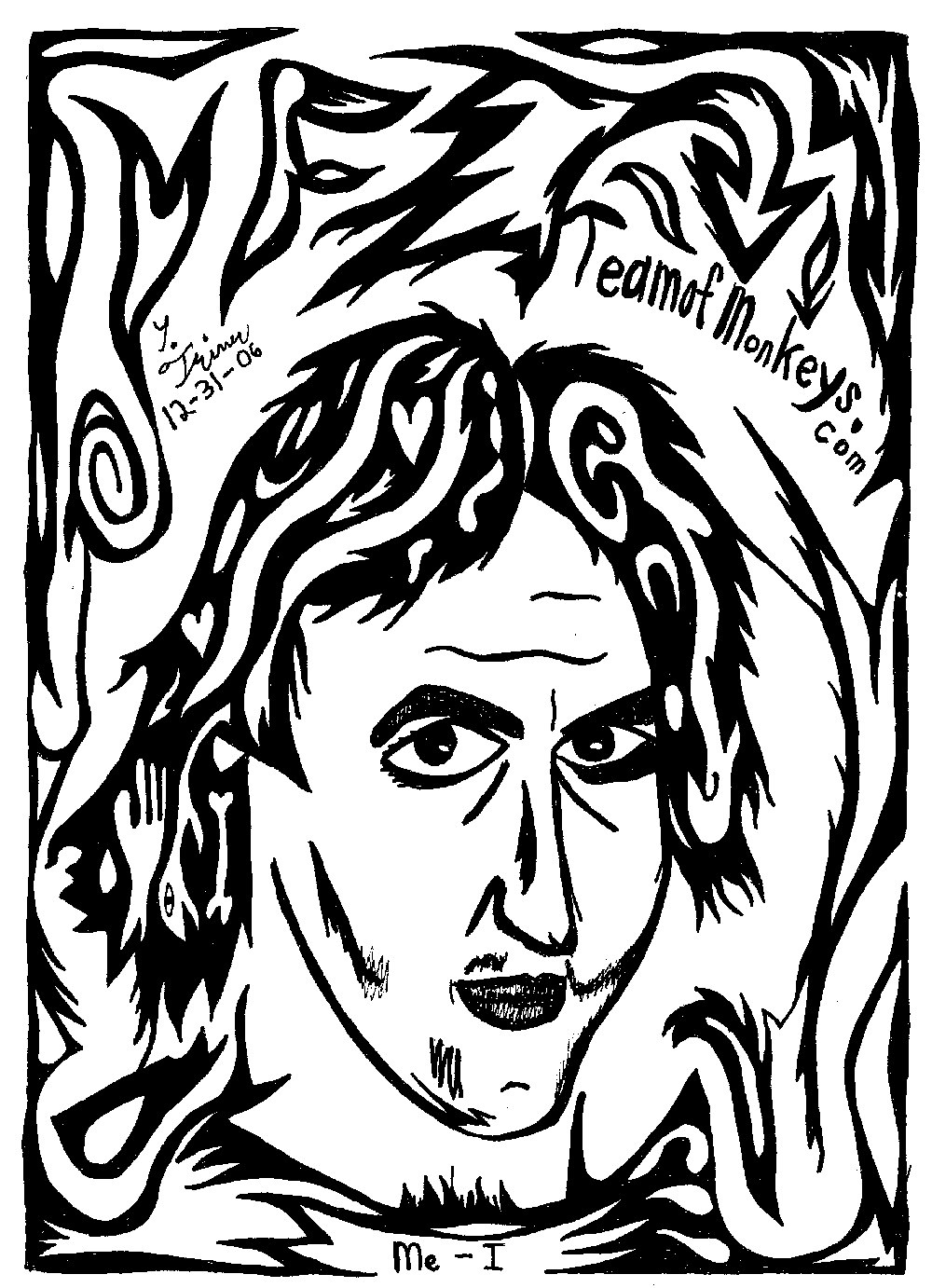
Yonatan Frimer began drawing mazes in the 3rd grade out of boredom. Anytime his mind would wonder off he'd simply whisk away the boredom with a few mazing pencil strokes - they didn't let him write with pens, yet, at that age.
Fast forward about 20 years later to when Yonatan broke his leg in a motorcycle accident and was hospitalized and bed bound for nearly 3 years. Too keep his mind as busy as possible during the recovery period, he focused on drawing mazes. As much as 15 hours a day, pretty much everyday, for nearly 3 years. He also practiced drawing not just mazes, but also portraits and caricatures as well as anime and plain old comics, which he often incorporates into better maze making.
After making several hundred mazes and posting them to the internet, Yonatan began getting many request for printing his mazes from various newspapers and magazine publications, which has grown over time to include millions of copies in 5 countries!
Until 2009, most of the mazes where posted to Team Of Monkeys . com . In Feb 2009, the mazes where renamed under the brand Ink Blot Mazes along with a higher production rate to meet the demands of publications and syndicates.


Some Maze Videos:
How naming the maze can make the maze:
I usually try to work the word MAZE in a funny way into some normal saying or catch phrase
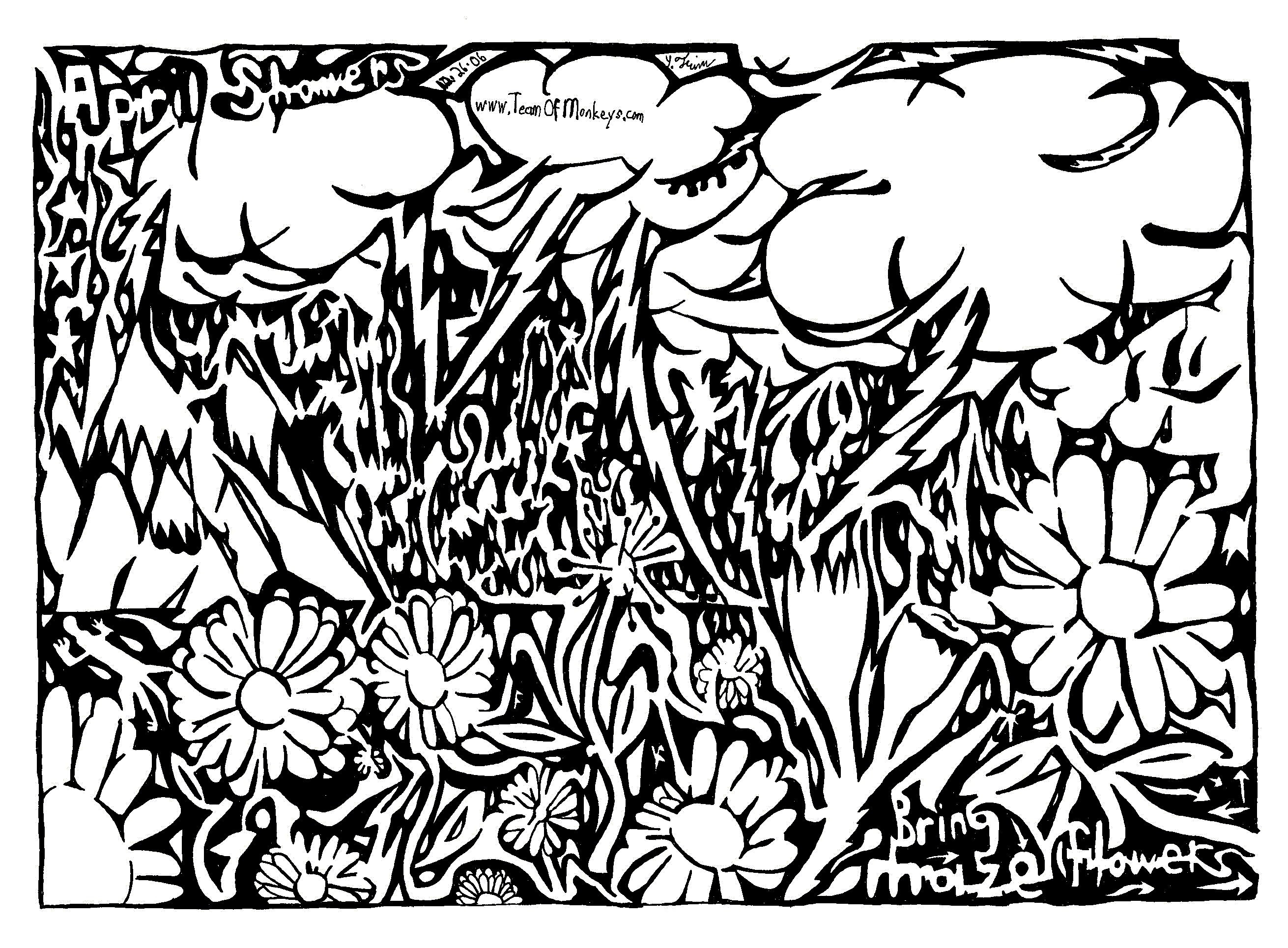
Mazerotti is intended to sound like Maserati, the exotic Italian sports car manufacturer.
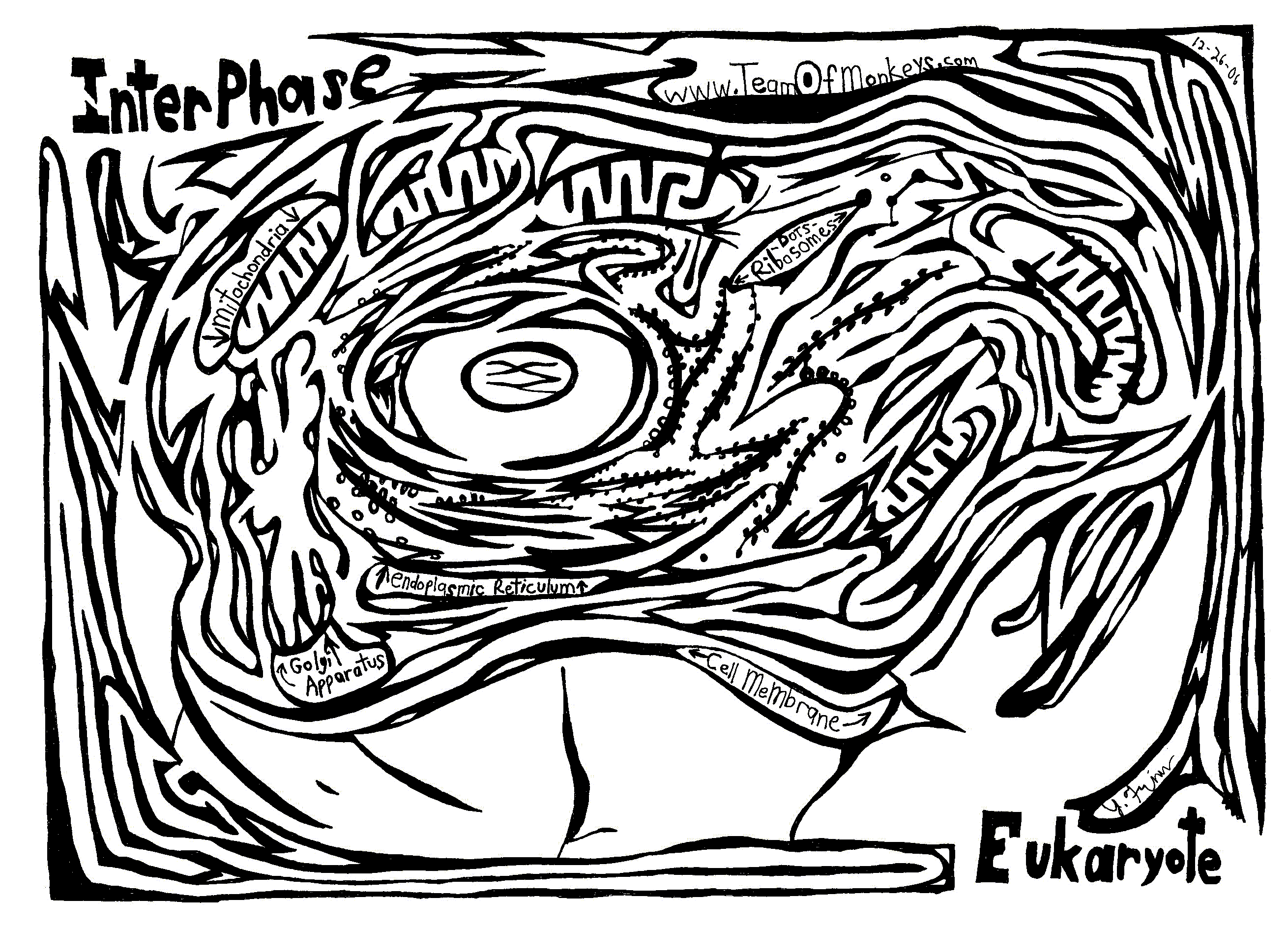
Somewhere in storage, near a Mediterranean coast, I have a booklet of mazes I titles Maze Anatomy
I guess you could call it a spin off the famous Anatomy Illustration Book, Grey's Anatomy.
Drawing Anatomically correct biology illustrations is much harder than, and not nearly as much fun, as it looks.
Here is one of the mazes from that collection: An Eukaryotic Cell. Can't imagine why these never really took off.
I have recently begun publishing my mazes and am very interested in speaking with any publishers.
Contact Info
Home Contact About the Artist Portfolio
Ink Blot Mazes
Friday, February 27, 2009
How Wind Turbines Work...
| How wind turbines work | |
| | |
| This percentage will no doubt increase in the years ahead and the sight of wind turbines scattered across landscapes will become an increasingly common occurrence. It's all a part of the battle to reduce global warming induced climate change and to reduce our reliance on fossil fuels. While we're likely most familiar with the huge turbines that crank out electricity for hundreds or thousands of residences, there are now many smaller options available for residential use. Wind and solar energy connection It's important to understand that wind is actually a form of solar energy - so by saying that a wind turbine harnesses solar power isn't totally incorrect. Wind is a phenomenon that occurs caused by the uneven heating of the Earth's surface in combination with the spinning of the planet on its axis. Turbine design A wind turbine, instead of operating like a fan in your home that uses electricity to create wind, uses wind to create electricity. The blades of the turbine are shaped in such a way that wind causes them to rotate, which spins a low speed shaft with a gear at the end which is connected to another smaller gear on a high speed shaft that runs through a generator housing. The generator creates electricity using much the same principle as the alternator on your car (depending on the turbine type). A magnetic rotor on the high speed shaft inside the generator housing spins inside loops of copper wire that are wound around an iron core. As the rotor spins around the inside of the core it creates "electromagnetic induction" through the coils that generates an electrical current. That current is then regulated and fed into the grid (or a residential grid connect system) after some modification so that it can be used in our homes or routed into a battery bank for storage. Where a battery bank is used, a regulator prevents overcharging. The most common wind turbine is the horizontal-axis, which looks somewhat like a traditional windmill, but there are also vertical-axis designs that look similar to an egg-beater or paddle wheel laid on its side.
In the horizontal-axis type, a yaw mechanism in the turbine shaft is utilized to turn the wind turbine rotor into the wind, increasing efficiency. In most cases with wind farm turbines, this is a powered by a small electric motor and computer monitoring. Turbine size and output Wind turbines for commercial electricity production usual range from 100 kilowatts to 5 megawatts. At the time of writing, the largest wind turbine in the world had a rotor diameter of 126 m (390 feet) and the potential to generate enough electricity for 5000 households. A wind turbine for home use has rotors between 8 and 25 feet in diameter and usually has the potential to generate between a few hundred watts and 6 kilowatts of electricity. Some wind turbines can be used in conjunction with a grid connect system. For every kilowatt hour of electricity produced by wind energy or other green means, approximately 1.5 pounds of carbon is prevented from going into the atmosphere if that electricity had been sourced from coal fired power plants. Carbon dioxide is a major contributor to global warming induced climate change. Wind speeds needed A wind turbine usually needs wind speeds of around 10 miles an hour (16kmh) to start generating electricity and optimum wind speed for large turbines is approximately 30 miles per hour ; so they aren't really an option if you're located in an area where winds are usually light and variable, although some models are now being produced that can generate electricity with as little as 5 mile per hour wind speeds - particularly vertical axis models. Wind speed usually increases with height and where there are no natural or man-made obstructions and this why you'll often see them on hilltops or perhaps in the middle of wheat fields. The wind energy industry has been a boon for many farmers as they can still crop their land with little interference and also generate an income from allowing the turbines on their property. Increasing numbers of wind farms are also being erected offshore. The blades of a wind turbine rotate at a rate of between 10 to 50 revolutions per minute. In a situation where wind speeds are excessive, for example if there's a gale, the turbine automatically shuts down to prevent damage. Turbine lifespan The lifespan of a modern turbine is pegged at around 120 000 hours or 20-25 years, but they aren't totally maintenance free. As they contain moving components, some parts will need to be replaced during their working life. From what I've researched, the cost of maintenance and parts replacement is around the 1 cent USD/ AU per kWh or 1.5 to 2 per cent annually of the original turbine cost. Environmental impact Wind turbines aren't overly noisy - mechanical noise is minimum these days and you'll mostly hear the swoosh of the blades passing the tower. Of course, if you're living close to a large wind farm, it could present some noise issues; but most countries have regulations regarding the placement of wind farms in relation to residential areas. Wind turbines are created from fiberglass, plastics, aluminium, copper, steel and various other metals, so they do have an impact on the environment in that respect and there's also the energy used to to manufacture the turbine. Many turbine parts are recyclable and it's my understanding the amount of energy used in manufacture is balanced out within six to eight months after being commissioned. Wind farms do have an impact on birds - there have been recorded cases of birds being killed by rotor blades when they fly into them; but there's a great deal of research being carried out to try and minimize the problem. It's also an issue taken into consideration in most countries when choosing a location for a wind farm in relation to bird migratory patterns. Costs and regulation for residential turbines Turbines used in residential situations are much quieter than their wind farm counterparts, but you'll need to check with your local authorities as they are still not permitted in some areas - this being the case, your best options for renewable energy is solar power. If you do meet resistance with your local council, talk to them about vertical turbine options as these emit lower noise, have a lower profile and are considered to be generally more aesthetically pleasing than their horizontal axis counterparts. As local government tends to be behind the times with technological developments in renewable energy, it doesn't hurt to raise the possibility of that alternative. Wind turbines for home use vary in price and greatly depend on your electricity needs vs. wind availability, but you can expect to pay around $12,000 to cater for the average home. However, bear in mind that cost can be greatly offset by renewable energy rebates offered by many governments. Many people think that wind turbines are ugly, and I tend to agree; but I feel that way about most things man made that are added to a natural landscape. Aesthetics aside, the other point that people should bear in mind that if we want to maintain the level of comfort we've grown accustomed to in our modern lives, there will always be some sort of price to pay beyond dollars and cents. | |


Subscribe to:
Posts (Atom)

